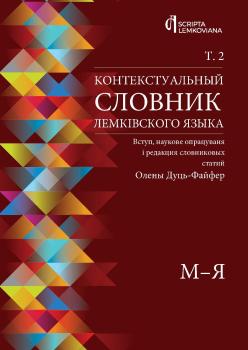
Контекстуальный словниклемківского языка: Т. 2
Keywords:
contextual dictionary, Lemko language, Lemko vocabulary, language revitalization, language immersionSynopsis
CONTEXTUAL DICTIONARY OF THE LEMKO LANGUAGE
Although the concept of a contextual dictionary does not generally function in lexicography, we have used it in order to emphasize the specific function of this dictionary, which is to capture the specificity of the Lemko language not only in terms of its lexical and semantic aspects, but also in terms of its entire structure of expression and verbal interaction. We are including this dictionary in the revitalization efforts undertaken for the highly endangered Lemko language, understanding its disappearance not only in quantitative terms (number of users), but also in qualitative terms (assimilation into the dominant language). The nuances of meaning of given lexemes, captured in context and meticulously activated in our dictionary, are part of an immersive revitalization method. In the case of minority languages, only this method of revitalization can be effective. On this basis, the multifunctional nature of the dictionary and the methodology of working on it are developed. The dictionary fulfills an explanatory/defining, normative, and cultural function. It strives to refer to the living, spoken language preserved in texts to the greatest extent possible. Therefore, it does not introduce highly organizing and schematizing norms for constructing dictionary entries, leaving the definition of entries to the individual choices and linguistic intuition of the authors of the basic version of these entries. This reflects the natural diversity of expression in a language that is based more on mechanisms of intra-community communication than on institutional support aimed at standardization, efficiency, and economy of communication. The dictionary was initially compiled by a team of revitalizers who were not professional lexicographers, but mostly native speakers (in the case of three people, neo-speakers) of the Lemko language. Naturally acquired linguistic forms and habits from the family environment were combined with patterns of definition developed mainly on the basis of the dominant language (Polish, and to a lesser extent Ukrainian or Russian) and the guidelines necessary for such a project, which had to be formulated at the beginning of the work and were subject to clarification or modification during the course of the work. The lexical material was drawn mainly from a text corpus developed by the team, which contains 1,891 Lemko-language texts published after 1945. The corpus also includes some Lemko dictionaries and lexicographical materials collected during field research or interviews conducted, for example, during the recording of documentary films. Texts from Lemko-language websites were also included. Sometimes the context was taken from so-called living speech, i.e., the use of a given lexeme recorded during conversations within the family or among friends. The valuable and diverse dictionary material prepared on the basis of these lexical resources underwent further significant editorial work. This work was not aimed at standardizing the material or making it similar to other highly systematized dictionaries. It focused mainly on revitalization and consisted primarily of adapting definitions that were artificial for the Lemko language, often copied from other dictionaries, to expressions and forms more appropriate to it. For example, noun forms, mainly verbal nouns, which were common in definitions, were replaced as far as possible with original verbal expressions more typical of indigenous languages. Particular attention was paid to lexical and structural Polonisms, frequent calques, and borrowings from Polish, and less frequently from Ukrainian. An important methodological assumption of the dictionary is the absence of translations into other languages. Knowing the situation of the Lemko language, which is increasingly using Polish language structures filled with Lemko vocabulary (very often direct calques from Polish), we believe that providing a database of such equivalents will weaken rather than strengthen the condition of this endangered language. Therefore, we consistently use language immersion.
Chapters
-
TABLE OF CONTENTS
-
Контекстуальный словник лемківского языка м–я .......... 5
-
Streszczenie .......... 1203
-
Summary .......... 1209
Downloads
References