
The Validity of the Right of the Defence Counsel (and the Suspect) to Meet Without Outsiders and to Communicate Without Interference in Lithuania, in Light of European Standards .......... 277

Authors

Evaldas Raistenskis
Vilnius University image/svg+xml
Rita Remeikienė
Vilnius University image/svg+xml
Ligita Gasparėnienė
Vilnius University image/svg+xml
Remigijus Merkevičius
Vilnius University image/svg+xml

Synopsis

THE VALIDITY OF THE RIGHT OF A DEFENCE COUNSEL (AND THE SUSPECT) TO MEET WITHOUT OUTSIDERS AND TO COMMUNICATE WITHOUT INTERFERENCE IN LITHUANIA, IN LIGHT OF EUROPEAN STANDARDS

Since around the end of 2009, the European Union has focused its attention on the rights and opportunities of suspects (defendants) in criminal proceedings. The right to actively defend oneself against charges is an ‘innate human right’ – a right that a person ‘brings into the material world at birth’, a right that no one has granted to a person, and therefore no one can take away (has no ‘right’ to do so). The right to defend oneself is an expression of one of the fundamental human needs – the need for justice. The suspect’s right to actively defend oneself, in terms of its content, is a ‘dual right’ – it encompasses the suspect’s (a.) ‘right to defend oneself (to defend oneself)’ and (b.) ‘the right to be defended by a professional lawyer’ – and only this synergy (of the joint efforts of the suspect and their defence counsel) gives the suspect’s ‘right to defence’ (the suspect’s defence as a procedural function) its greatest effectiveness. The aim of this article is to reveal the content and effectiveness of the right of the defence counsel (and, consequently, the suspect) to meet without outsiders and to communicate unimpeded within the Lithuanian criminal justice system, and to assess the compliance of prevailing practice in Lithuania with the standards set by international law and European Union law.
Author Biographies

Rita Remeikienė, Vilnius University

Rita Remeikienė is a Senior Researcher at the Department of Criminal Justice of the Faculty of Law at Vilnius University. Her research focuses on the shadow economy, corruption, money laundering, the Green Deal, selfemployment, and labour market issues. She is the author and co-author of numerous international scientific publications, monographs, and research projects, and her work contributes to evidence-based policymaking and socio-economic development.

Ligita Gasparėnienė, Vilnius University

Ligita Gasparėnienė is a professor at the Department of Criminal Justice of the Faculty of Law at Vilnius University. Her research focuses on the shadow economy, corruption, money laundering, sustainability, and renewable energy. She is the author of numerous international scientific publications, monographs, and research projects, and is an active expert in her field.

Remigijus Merkevičius, Vilnius University

Remigijus Merkevičius is an attorney-at-law, Associate Professor at the Department of Criminal Justice of the Faculty of Law at Vilnius University. He is one of Lithuania’s leading experts in criminal procedure law. His academic and professional work focuses on criminal procedure, human rights, and defence in criminal proceedings. He is the author of numerous scientific publications and monographs and is an active legal expert in the public sphere.

Published

26 November 2026

How to Cite

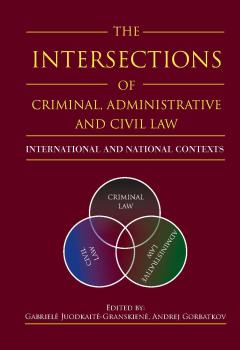
Raistenskis, Evaldas, Rita Remeikienė, Ligita Gasparėnienė, and Remigijus Merkevičius. 2026. “The Validity of the Right of the Defence Counsel (and the Suspect) to Meet Without Outsiders and to Communicate Without Interference in Lithuania, in Light of European Standards . 277”. In The Intersections of Criminal, Administrative and Civil Law: International and National Contexts, edited by Gabrielė Juodkaitė-Granskienė and Andrej Gorbatkov, 277-336. Poland: Księgarnia Akademicka Publishing. https://doi.org/10.12797/9788383685328.12.